
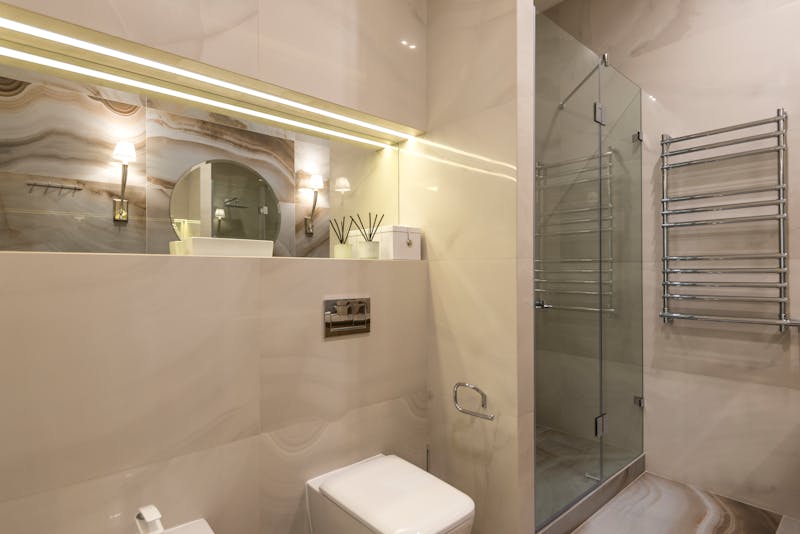
A bathroom renovation is one of the most common home improvement projects in Sydney — and one of the most electrically complex. Bathrooms combine water and electricity in a confined space, which means strict regulations govern every aspect of the electrical work. Get it wrong and you're looking at compliance failures, insurance issues, and genuine safety risks.
This guide covers everything you need to know about bathroom electrical requirements in NSW, whether you're doing a full gut renovation or a cosmetic refresh that involves any electrical changes.
Understanding Bathroom Electrical Zones
The most important concept in bathroom electrical work is zoning. AS/NZS 3000 (the Wiring Rules) divides bathrooms into zones that determine what electrical equipment can be installed where. These zones are based on distance from the bath or shower:
Zone 0 — Inside the Bath or Shower
- The interior of the bathtub or shower recess itself
- Only SELV (Safety Extra-Low Voltage) equipment rated IPX7 is permitted — essentially just in-tile lighting at 12V maximum
- No power points, no switches, no 240V equipment whatsoever
Zone 1 — Directly Above the Bath or Shower
- The area directly above the bath or shower up to 2.25m from the floor
- Water heaters and shower pumps rated IPX4 minimum are permitted
- Fixed lighting rated IPX4 is allowed (common for shower recessed lights)
- No power points or standard switches
- Must be on an RCD-protected circuit
Zone 2 — Within 600mm of the Bath or Shower
- Extends 600mm horizontally from the edge of the bath or shower, and up to 2.25m high
- Luminaires, fans, heaters, and towel rails rated IPX4 are permitted
- Shaver sockets with isolating transformer are allowed
- No standard power points
Zone 3 — Beyond 600mm
- Everything beyond 600mm from the bath or shower edge
- Standard power points are permitted (must be RCD protected)
- Light switches are permitted
- All standard electrical equipment is allowed
Getting zone compliance right is critical. An incorrectly positioned power point or switch can fail inspection and may need to be relocated — which means ripping into freshly tiled walls.
Mandatory Electrical Requirements
RCD (Safety Switch) Protection
Every circuit supplying a bathroom must be protected by an RCD (safety switch) with a maximum rating of 30mA. This is non-negotiable under AS/NZS 3000. If your existing switchboard doesn't have RCD protection on the bathroom circuit, it must be added as part of the renovation.
Exhaust Ventilation
Under the Building Code of Australia (BCA) and AS 1668.2, bathrooms without an openable window to the outside must have mechanical exhaust ventilation. Even if your bathroom has a window, we strongly recommend an exhaust fan — Sydney's humidity means moisture damage and mould are real problems without adequate ventilation.
Exhaust fan requirements:
- Minimum extraction rate: 25 litres per second for a standard bathroom
- Ducting: Must be ducted to the outside — not into the ceiling cavity (a surprisingly common non-compliant shortcut)
- Timer or humidity sensor: Best practice is a fan that runs for 10-15 minutes after the light is switched off, or one with a built-in humidity sensor
- Zone compliance: The fan motor and any electrical connections must comply with the zone it's located in
IP Ratings for Fittings
Every electrical fitting in a bathroom needs an appropriate Ingress Protection (IP) rating for its zone:
- Zone 0: IPX7 minimum (protected against immersion)
- Zone 1: IPX4 minimum (protected against splashing)
- Zone 2: IPX4 minimum
- Zone 3: Standard IP ratings acceptable for most equipment
Common Bathroom Electrical Installations
Lighting
Good bathroom lighting requires layers — ambient, task, and accent:
- Recessed LED downlights: The standard choice for general illumination. Use IC-4 rated, IP44-rated fittings in Zones 1 and 2. We recommend 4000K (cool white) for bathrooms — it provides better colour rendering for grooming tasks
- Vanity mirror lighting: Wall-mounted lights either side of the mirror (or a backlit mirror) eliminate shadows on the face. Critical for shaving and makeup application
- LED strip lighting: Under floating vanities, behind mirrors, or in niches creates beautiful ambient effects. Use IP65-rated strips in wet areas
- Dimming: A dimmer on bathroom lights lets you go from bright task lighting to relaxed bath-time ambiance. The dimmer switch must be in Zone 3 or outside the bathroom
Heated Towel Rails
A heated towel rail is one of the most popular bathroom upgrades. Two installation types:
- Hardwired: Connected directly to the electrical system by an electrician. Cleaner look with no visible cord or plug. Must be installed in Zone 2 or 3 with appropriate IP rating. Requires a dedicated connection point and ideally a timer or switch
- Plug-in: Plugs into a standard power point. The power point must be in Zone 3. Less expensive to install but the cord and plug are visible
Underfloor Heating
Electric underfloor heating in a bathroom is a luxury that's surprisingly affordable. The heating mat is installed under tiles and connected to a thermostat (usually wall-mounted outside the bathroom or in Zone 3). Requires a dedicated circuit from the switchboard and RCD protection.
3-in-1 Bathroom Units (Heat/Light/Fan)
Combination units that provide heating, lighting, and ventilation are popular in Sydney bathrooms. They require:
- A dedicated circuit (they draw significant power — typically 1,000-2,400W)
- Proper ceiling support (they're heavier than standard light fittings)
- Zone 1 or 2 compliance with appropriate IP rating
- Correct ducting to exterior for the exhaust component
Planning Your Bathroom Electrical Layout
The best time to plan bathroom electrics is before any demolition starts. Changes after tiling are expensive and disruptive. Work with your electrician to determine:
- Exact positions of shower, bath, and vanity (these define the zones)
- Number and position of downlights
- Vanity mirror lighting type and position
- Power point locations (must be Zone 3)
- Heated towel rail position and type (hardwired vs plug-in)
- Exhaust fan position and ducting route
- Switch positions (ideally outside the bathroom door or in Zone 3)
- Whether you need a new circuit from the switchboard
Bathroom Electrical Costs (Sydney 2026)
- Exhaust fan (supply + install + ducting): $300–$600
- LED downlights (4-6, supply + install): $400–$800
- Vanity mirror lighting: $200–$500
- Heated towel rail connection (hardwired): $200–$400
- Power point installation: $150–$250 each
- 3-in-1 unit (supply + install): $500–$900
- Underfloor heating (average bathroom): $800–$1,500
- New circuit from switchboard: $300–$500
- Typical total bathroom electrical package: $1,500–$4,000
Certificate of Compliance
All bathroom electrical work requires a Certificate of Compliance (CCEW) to be issued by the licensed electrician and lodged with NSW Fair Trading. This certifies the work meets Australian Standards and is safe. Keep this certificate — you'll need it if you sell the property or if an insurance claim ever arises.
Frequently Asked Questions
Can I have a power point in my bathroom in NSW?
Yes, but only in Zone 3 — at least 600mm from the edge of the bath or shower. The power point must be protected by an RCD (safety switch), and shaver sockets on isolating transformers can be installed closer. Standard power points cannot be installed within Zones 0, 1, or 2.
Do I need an electrician for a bathroom renovation?
Absolutely. All electrical work in bathrooms must be performed by a licensed electrician in NSW. Bathrooms are classified as wet areas with strict zone regulations under AS/NZS 3000. A licensed electrician must issue a Certificate of Compliance (CCEW) for all bathroom electrical work.
Is an exhaust fan mandatory in a bathroom in NSW?
Under the Building Code of Australia and AS 1668.2, bathrooms without an openable window must have mechanical ventilation (exhaust fan). Even bathrooms with windows benefit from exhaust fans to prevent moisture damage and mould growth.
Can I install a heated towel rail myself?
No. Hardwired heated towel rails must be installed by a licensed electrician. Even plug-in models in a bathroom must comply with zone regulations — the plug and socket must be in Zone 3 (at least 600mm from the bath or shower). Your electrician will ensure correct RCD protection and zone compliance.
How much does bathroom electrical work cost during a renovation?
Typical bathroom electrical costs in Sydney range from $1,500 to $4,000 depending on scope. This includes exhaust fan installation ($300–$600), lighting ($400–$1,200 for downlights), heated towel rail connection ($200–$400), power points ($150–$250 each), and a new circuit from the switchboard if needed ($300–$500).
Get Your Bathroom Electrical Right First Time
Bathroom electrical work needs to be planned before tiling and waterproofing — not after. Call Randwick Electrical on 0413 707 758 to discuss your bathroom renovation. We'll coordinate with your builder and tiler to make sure everything is in the right place, compliant, and done properly.