
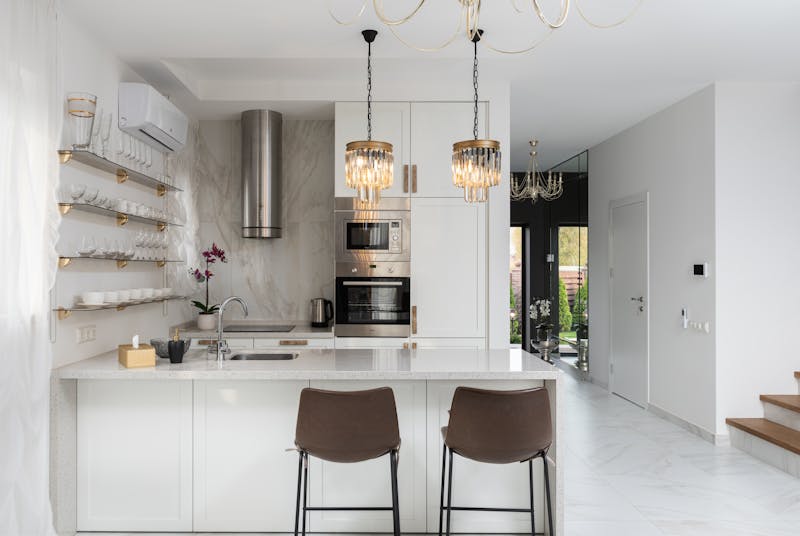
The kitchen is the most electrically demanding room in any home. Between cooking appliances, refrigeration, lighting, ventilation, and the ever-growing collection of bench-top gadgets, a modern kitchen can easily require 6–10 dedicated circuits and a dozen or more power points. Getting the electrical layout right during a renovation is critical — because once the cabinetry is in and the tiles are grouted, changes are expensive and disruptive.
Dedicated Circuits: What Needs Its Own?
A dedicated circuit means a cable running from your switchboard directly to one appliance — not shared with anything else. In a modern kitchen, the following appliances need dedicated circuits:
Oven / Wall Oven
- Typically requires a 20A or 32A circuit depending on the oven's power rating
- Hardwired — no plug and socket. Connected directly via an isolating switch behind or beside the oven
- Standard electric ovens draw 2,400–4,800W
- Double ovens may need a 32A circuit
Cooktop (Induction or Ceramic)
- Induction cooktops are power-hungry — typically 7,200W for a standard 4-zone unit
- Requires a dedicated 32A circuit with 6mm² cable minimum
- Some large induction cooktops (5-zone, commercial-style) may need a 40A or even three-phase supply
- Gas cooktops still need an electrical connection for ignition — typically a standard power point behind the unit
Dishwasher
- Dedicated 10A or 15A circuit recommended
- Power point positioned in the adjacent cabinet void for easy access
- Must be accessible for disconnection without moving the dishwasher
Refrigerator
- Dedicated 10A circuit strongly recommended
- A fridge on a shared circuit risks losing power if another appliance trips the breaker — and nobody wants to come home to a warm fridge
- Position the power point behind the fridge recess, slightly off-centre so it doesn't prevent the fridge sitting flush
Microwave
- Dedicated or semi-dedicated circuit (can share with rangehood if loads are managed)
- Built-in microwaves need a power point in the cabinet void above or behind
- Standard benchtop microwaves draw 1,000–1,500W
Rangehood
- Needs a connection point above the cabinetry or inside the rangehood cavity
- Some canopy rangehoods are hardwired; others use a plug and socket
- Check the rangehood specifications before roughing in — the connection point location varies by model
Bench-Top Power Points
This is where most kitchens fall short. A modern kitchen needs far more bench-top power points than you think. Our recommendation:
- Minimum one power point per metre of bench space — more is better
- Double power points as standard — a single outlet is almost useless in a kitchen
- Position 100mm above the splash-back — or integrated into the splash-back for a cleaner look
- Consider USB-C points at the breakfast bar or charging station area
Think about what actually sits on your bench: kettle, toaster, coffee machine, stand mixer, blender, food processor, air fryer. Most households use 4–6 bench appliances regularly. You need enough points that nothing requires unplugging something else.
Island Bench Power
Kitchen islands are increasingly popular in Sydney renovations, especially in open-plan layouts. Getting power to an island requires planning because there's no wall to run cables through. Options include:
- Floor cable run: Cable is run under the floor slab or through the subfloor to a point beneath the island. The most common and cleanest solution in renovations where the floor is being replaced
- Pop-up power points: Retractable units that sit flush in the benchtop when not in use. Available in 2-point and 4-point configurations, some with USB. Look great and keep the benchtop clean
- Side-mounted outlets: Power points installed in the side or end panel of the island. Less visible than surface-mounted but always accessible
- Ceiling drop: In some cases, power can be dropped from the ceiling through a pendant or decorative column. Less common but an option when floor access is impossible
Kitchen Lighting Design
Kitchen lighting needs to work hard — you're doing detailed tasks (chopping, reading recipes) alongside entertaining and general living. A layered approach is essential:
General Lighting
Recessed LED downlights are the workhorse. Use 4000K (cool white) for kitchens — it provides the best colour rendering for food preparation and makes the space feel clean and bright. Space at 1.2–1.5m intervals for even coverage.
Task Lighting
Under-cabinet LED strip lighting illuminates the bench-top directly — no shadows from overhead lights blocked by wall cabinets. This is the single best lighting upgrade for any kitchen. Options:
- LED strip channel mounted under wall cabinets
- 4000K colour temperature for task work
- Switched separately from overhead lights
- Dimmable for evening ambiance
Feature Lighting
Pendant lights over an island bench provide both task lighting and visual interest. Choose pendants that complement your kitchen style and hang them 700–850mm above the benchtop. Typically 2–3 pendants for a standard island, evenly spaced.
Switchboard Capacity
A kitchen renovation often adds 4–8 new circuits. Before starting, check whether your switchboard has capacity for the additional circuits. Many older homes in Sydney's Eastern Suburbs have switchboards that are already at capacity — a switchboard upgrade may be needed as part of the renovation.
Kitchen Electrical Costs (Sydney 2026)
- Dedicated oven circuit (32A): $400–$600
- Dedicated cooktop circuit (32A): $400–$600
- Dedicated appliance circuits (each): $300–$500
- Bench-top power points (each double): $150–$250
- Island bench power (inc. floor run): $500–$1,200
- LED downlights (per light, supply + install): $75–$120
- Under-cabinet LED strip lighting: $300–$600
- Pendant light installation (per pendant): $100–$200
- Rangehood connection: $150–$300
- Typical total kitchen electrical package: $2,500–$6,000
Frequently Asked Questions
How many power points do I need in a kitchen?
A well-planned kitchen typically needs 8–14 power points: at least one every metre along bench tops for small appliances, dedicated outlets for the fridge, dishwasher, and microwave, plus points for rangehood and waste disposal. Island benches need 2–4 additional points. It's always better to have too many than too few.
Does an oven need its own circuit?
Yes. Electric ovens draw 2,400–4,800W and must be on a dedicated circuit — typically a 20A or 32A circuit depending on the oven's rating. The oven is hardwired (no plug), and the circuit must have its own circuit breaker at the switchboard. An induction cooktop also requires its own dedicated circuit, often 32A.
Can I add power points to a kitchen island bench?
Absolutely. Power points can be installed in island benches via pop-up units that sit flush when not in use, outlets in the side or end of the island, or floor outlets with cable runs under the slab. The best time to plan island power is during renovation when the floor is accessible.
What lighting is best for a kitchen?
The best kitchen lighting combines three layers: recessed LED downlights (4000K cool white) for general illumination, under-cabinet LED strip lighting for task illumination on bench tops, and pendant lights over island benches for style and focused light. Dimming on general lights adds versatility.
How much does kitchen electrical work cost in a renovation?
Kitchen electrical costs in Sydney typically range from $2,000 to $6,000 depending on scope. This covers new circuits for appliances ($300–$500 each), power point installation ($150–$250 each), LED downlights ($75–$120 each), under-cabinet lighting ($300–$600), and appliance hardwiring ($150–$300 per appliance).
Plan Your Kitchen Electrical Early
The golden rule for kitchen electrical: plan it before the cabinets are ordered. Power point positions depend on cabinet layout, and appliance circuits depend on what you're installing. Call Randwick Electrical on 0413 707 758 — we'll review your kitchen plans and design an electrical layout that works perfectly with your renovation.